WSM Casino Complaints and Reputation Signals
 Available in GB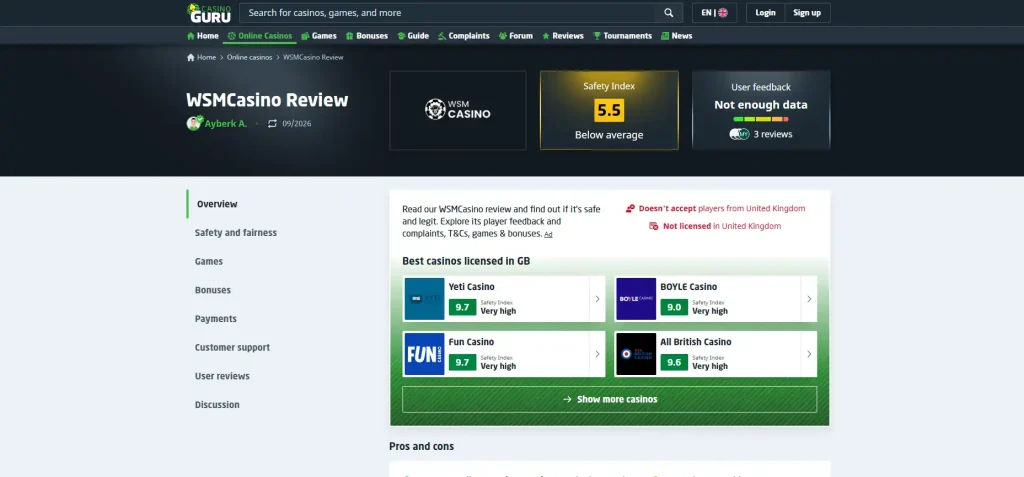
Public complaint databases contain WSM Casino cases, but the totals and classifications differ between services.
As of 29 September 2026, AskGamblers presents a different set of WSM complaint figures.
Table of Contents
- Casino Guru currently assigns a 5.5 Safety Index
- The Casino Guru complaint panel contains several status types
- One recent open case concerns account closure after verification
- Casino Guru also records a resolved self-exclusion complaint
- An unresolved complaint involved a closed account and disputed winnings
- AskGamblers shows eight resolved WSM complaints
- A resolved complaint does not always mean the player won
- Complaint themes should be drawn from cases, not invented from headlines
- Complaint totals differ between Casino Guru and AskGamblers
- User ratings are separate from complaint outcomes
- Public complaint databases are not a census of all support problems
- What the complaint records can and cannot show
- How to use WSM complaint data without overreading it
Casino Guru currently assigns a 5.5 Safety Index
Casino Guru gives WSM a Safety Index of 5.5 and labels that score “Below average”. The label belongs to Casino Guru and is not a UKGC classification.
Casino Guru says its Safety Index considers terms and conditions, complaints, estimated casino size, blacklists, related casinos and other factors. It also states that user-review sentiment is not used directly in the Safety Index calculation. That distinction is important because a review score can otherwise look like a simple average of star ratings when it is not.
The same page says Casino Guru found no unfair or predatory clauses in the WSM terms it reviewed, while its complaint ratio was assessed negatively relative to the site’s estimated size. Those two observations pull in different directions, which is another reason not to reduce the whole picture to one adjective.
The Casino Guru complaint panel contains several status types
Casino Guru lists 25 complaints in its broader complaint-ratio dataset: 1 opened, 1 unresolved, 8 resolved and 15 rejected. It also states that its Safety Index can consider complaints about related casinos, so that total should not be read as 25 direct current WSM cases.
A resolved complaint means the case reached an outcome that allowed the complaint service to close it as resolved; a rejected or unresolved case has a different status and should not be counted as the same outcome.
Those categories should therefore stay visible. Reporting “25 complaints” without status information would lose much of the useful context.
One recent open case concerns account closure after verification
As of 29 September 2026, the complaint was still open and waiting for the player to reply.
This case should not be presented as proof of a general WSM practice because it is still an individual unresolved process. Its value is narrower: it shows that account duplication, verification and balance treatment can intersect in real complaint handling.
Readers dealing with verification should therefore use the WSM verification for the documented process and treat complaint cases as experience data rather than policy text.
Casino Guru also records a resolved self-exclusion complaint
A separate Casino Guru case submitted in April 2026 involved a player who said the account remained active despite repeated closure requests connected to gambling problems. The complaint record states that the account was ultimately closed and the case was marked resolved after the player confirmed settlement of the issue.
The case is relevant because it concerns an account-control workflow rather than a payment dispute. It should not be generalised into a claim that WSM always ignores or always handles self-exclusion requests correctly. It is one documented case with a resolved status.
WSM account controls should not automatically be treated as part of the UKGC or GAMSTOP framework. An operator can have its own closure tools without those tools being the same as Great Britain licensed-market protections.
An unresolved complaint involved a closed account and disputed winnings
Casino Guru classified the complaint against the casino and assigned black points within its own scoring system.
The unresolved case involved account closure after ID and address verification, and the disputed amount was material to the player.
For readers, the operational link is clear: account terms, multiple-account rules, game-specific restrictions and verification records can matter at withdrawal. The WSM withdrawals explains how to distinguish operator processing from blockchain settlement.
AskGamblers shows eight resolved WSM complaints
AskGamblers’ current WSM complaint pages display 8 of 8 complaints as resolved. The site reports an average complaint amount of $447, an average complaint duration of five days and an average operator response time of two days. These metrics belong to AskGamblers’ own complaint service and the cases it accepted and processed.
Several visible cases involve account closure, verification and withdrawal-related disputes. In some cases AskGamblers concluded that WSM acted in accordance with its terms. In others, a refund or other resolution was reached during the complaint process.
The presence of eight resolved cases is not directly comparable with Casino Guru’s broader total of 25 because the two publishers use different databases, acceptance rules and status systems. A reader should not add the totals together or calculate a combined “resolution rate”.
A resolved complaint does not always mean the player won
One AskGamblers WSM complaint was closed after the service concluded that the casino had acted in accordance with its terms, showing that a resolved status does not always mean the player received the outcome originally requested.
This distinction is crucial when reading complaint statistics. “Resolved” can mean the dispute was settled, the operator paid, the player accepted an outcome, or the complaint service concluded that the operator’s position was supported. It should not be translated automatically into “player reimbursed”.
Complaint themes should be drawn from cases, not invented from headlines
The current WSM case set supports several recurring subject areas: account closure, identity or address verification, delayed withdrawals and disputes over retained balances. Those themes appear in the actual case summaries across Casino Guru and AskGamblers.
These cases do not establish that WSM systematically withholds funds or that verification is deliberately used to avoid payouts. They are individual disputes with case-specific facts and outcomes.
The useful takeaway is operational. If a reader uses WSM, records of account details, verification submissions, withdrawal requests and communications can be important if a dispute later needs to be reconstructed.
Complaint totals differ between Casino Guru and AskGamblers
Complaint counts are not a direct measure of total player population. A large casino can generate more cases simply because more people use it, while a small casino can look quiet because fewer players know about a particular complaint service. Some databases also pull in complaints involving related casinos, while others count only cases filed directly against the named brand.
The two services count and classify cases differently, which explains why their totals are not directly comparable.
User ratings are separate from complaint outcomes
AskGamblers currently shows a player rating based on a small set of reviews, while Casino Guru says it does not yet have enough WSM user reviews to calculate a user-satisfaction score. Neither metric should be treated as a substitute for complaint case details.
That distinction helps explain why complaint decisions and user-star ratings should not be treated as the same signal.
Public complaint databases are not a census of all support problems
A public complaint database shows only the disputes that reached that service and were accepted into its process, not every support issue experienced by every WSM customer.
This is why complaint data is most useful for studying documented dispute types and outcomes rather than estimating the exact percentage of WSM customers who experience problems.
What the complaint records can and cannot show
Casino Guru and AskGamblers organise complaint data differently, so their totals should not be added together. Casino Guru’s September 2026 WSM panel shows a 5.5 Safety Index and a broader complaint-ratio set of 25 cases: 1 opened, 1 unresolved, 8 resolved and 15 rejected. Casino Guru also states that its scoring can include related casinos, which means that broader figure is not the same thing as a count of direct WSM complaints submitted to its own service.
As of 29 September 2026, AskGamblers shows 8 of 8 handled WSM complaints as resolved. It also displays an average complaint amount of $447, an average duration of five days and an average response time of two days. Those figures belong to the AskGamblers service and should be read within its own case-selection and status system rather than combined with Casino Guru’s figures.
The status labels themselves have different meanings. A resolved case has reached an outcome that allows the service to close it as resolved, but that does not always mean the player received everything originally requested. A rejected case can mean the complaint did not meet the service’s criteria or that the available information supported the operator’s position. An unresolved case indicates that the dispute did not reach a satisfactory resolution under that service’s process.
The individual cases also show why account and verification issues can be important. One Casino Guru case submitted on 17 September 2026 involved a German player’s account being closed after a previous account was discovered during verification, with an approximately €500 balance disputed. Another unresolved case involved a Slovenian player whose account was closed after identity and address checks and whose disputed balance was not fully paid.
AskGamblers cases show different outcomes. One complaint about a closed account and disputed funds was closed after AskGamblers concluded that the casino had acted in accordance with its terms. Another account-freeze case was marked resolved after the player reported that the operator had provided a refund route. These examples show that the same status label can cover different practical outcomes.
Public complaint databases are still only a selected sample of player problems. Many issues are handled through ordinary support, some players abandon a complaint and some services decline cases that fall outside their rules. The records can show recurring themes such as account closure, KYC, delayed withdrawals and balance disputes, but they do not establish a universal outcome for every WSM account or prove a motive across all cases.
Complaint volume also needs a denominator that the public databases do not provide. A total number of cases cannot by itself show what share of all WSM customers experienced a problem, because the total player population and the number of disputes handled privately are unknown. The databases are therefore more useful for examining documented case types and outcomes than for calculating a complaint rate for the whole customer base.
The cases are most informative when read alongside the account action involved. Verification disputes can turn on identity documents or previous accounts, withdrawal disputes can involve operator processing before a blockchain transfer, and account-closure cases can depend on the terms applied to the account. Those details are more useful than treating every complaint as the same type of event.
How to use WSM complaint data without overreading it
Casino Guru assigns WSM a 5.5 Safety Index under its own scoring system, while AskGamblers reports its own handled-case figures and timing metrics.
Those facts can help a reader understand what kinds of problems have reached public complaint services, but they do not establish a universal outcome for every account. The publishers apply different methods, complaint statuses do not all mean the same thing, and some Casino Guru scoring inputs involve related casinos rather than WSM alone.
The useful approach is to compare the different case types and outcomes without treating one complaint metric as a complete picture.
Related WSM topics: WSM Casino review; and WSM licence and safety.
Recommend

WSM Casino Games: Slots, Tables and Providers
The WSM game lobby spans slots, table games, live dealer titles and other categories across...

WSM Casino Licence, Safety and UK Regulatory Context
The UKGC public register is the relevant Great Britain licensing record for WSM. WSM Casino...

WSM Casino Payment Methods for UK Readers
WSM's cashier is centred on cryptocurrency deposits and withdrawals across supported assets and networks. WSM...

WSM Casino Mobile Experience: Browser, iPhone and Android
WSM's mobile experience is browser-based, with account, games and cashier functions adapted to smaller screens....

WSM Casino Bonuses and Promotions
The WSM welcome promotion combines a deposit match with casino and sportsbook extras, while the...
WSM Casino Registration and Account Setup
WSM registration can involve email credentials, wallet options and country selection, all of which may...